Pages

Showing posts with label Entertainment. Show all posts

Friday, 2 December 2016

Zahra Buhari’s wedding Suddenly postponed


According to NBC, The wedding ceremony of Zahra, the daughter of President Muhammadu Buhari, has Suddenly  been postponed. The ceremony, which was scheduled for this weekend, was moved as a result of President Buhari’s insistence on a low-key wedding for the 21-year-old bride to be, Daily Trust reported.
It was gathered that the president is uncomfortable with the attention the media is giving to the wedding especially recent reports about the groom’s family presenting 30 Louis Vuitton bags to Zahra.
An introduction ceremony between both families had earlier held at the Aso Villa, Abuja on Friday, November 18, with the wedding programme scheduled between November 30 and Sunday, December 4, 2016.
Contact Editor @nsiscoxpress 

Monday, 21 November 2016

Tiny Device Allows You To Track Your Car Using Your Smartphone


 checkout this concept technology, have you ever lost your car on a parking lot? It happens. You park and go shopping. When you get back, you don't have a clue where your car is. Then you start roaming around clicking on the panic button on your car keys so the alarm goes off. It can be frustrating, especially on a hot, sunny day.
No, you don't need to install an expensive GPS system to keep track of your car. That's way too expensive. You would need to pay a monthly subscription fee just to use it. Don't we have enough bills to pay already?
But is there a way to track your vehicle without spending a fortune? Yes, now there is!
A California-based startup company was able to make this a reality. They created a tiny device that works with your smartphone, and it could be exactly what you're looking for!

What is it?


It's called TrackR. It is a state-of-the-art tracking device the size of a quarter. It's changing the way we keep track of the important things in our lives.

How Does it Work?

It's easy! Install the free TrackR app on your smartphone, connect the app to your device and you're ready to go! Simply attach TrackR to whatever you want to keep tabs on. The entire process of setting it up only takes 5 minutes or less.
You can attach it to your keys, briefcase, wallet, your latest tech gadgets and anything else you don't want to lose. Then use the TrackR app to locate your missing item in seconds.
Forget expensive GPS systems or tracking services. Nobody wants to pay expensive monthly subscription fees. We understand how stressful these things can be, and this is the reason why TrackR was created. This device is your VIP when you need to take care of more important things in life.
Remember the car scenario above? If you have the TrackR, you can just hide it under your car's floor mat, in the trunk or in the glove compartment. Somewhere it won't be found if your car gets stolen.
If you forget where you parked your car, whip out your smartphone and open the TrackR app. Tap on the "lost item" icon on the screen and the app will tell you the exact coordinates of the last known location of the TrackR.

How Much is it Going To Cost Me?

You're probably thinking that this device is very expensive... False! TrackR only costs $29! That's a small price to pay for peace of mind, isn't it?

Where can I buy TrackR?

You can buy it directly from the company's website. They ship worldwide and you'll receive your TrackR within a ~week.

What else can I do with TrackR?

As we said before, TrackR has unlimited possibilities. The device is small and unobtrusive enough that you can attach it to your pet. Put it on their collar, and the issue of searching for them as they scamper off to nearby places will be over! Attach it to your keys and wallet, and never waste a minute rummaging the whole house for it.
TrackR even comes with a double-sided adhesive so you can stick it to your laptop or under your bike seat. Track down and punish the thieves who steal your expensive things!
Attach it to everything that's important to you!

Apple has admitted that some iPhone 6S devices can suddenly shut down for no apparent reason.


Naijabroadcast  reports that  tech giant is offering owners of the problematic smartphones free replacement batteries."A very small number" of iPhone 6S devices manufactured between September and October 2015 are affected, Apple (AAPL, Tech30) said in a statement Monday. It didn't provide details on the battery fault that is causing the phones to unexpectedly go dark.
Apple will fix iPhone 6 Plus devices with 'Touch Disease'
Apple's announcement comes less than a week after a consumer watch group in China launched an investigation into the problem. "A considerable number" of Chinese users reported their iPhone 6 and 6S devices would suddenly turn off despite showing plenty of battery life, the China Consumers Association said in a statement. The phones would not turn back on even when plugged into chargers, according to the consumer group.
Apple said the battery problem is "not a safety issue." Its big rival Samsung pulled its flagship Galaxy Note 7 smartphone after repeated reports of the devices bursting into flames. Samsung initially said batteries in some Note 7 phones were to blame but is yet to fully explain the cause.
More than 500 South Koreans sue Samsung over botched Note 7 recallApple's battery replacement offer for the iPhone 6S applies worldwide. Owners of eligible phones with cracked screens will have to repair them before getting the new battery, Apple said. Consumers were plagued by a similar iPhone problem earlier this year. A software glitch with the iPhone 6S and 6S Plus caused the battery icon to display more battery life than was actually left, leaving many people frustrated when their phones appeared to suddenly shut down. The company fixed the problem with an operating system update.
And just last week, Apple acknowledged iPhone 6 Plus devices suffer from  "Touch Disease" -- when the phone's touchscreen stops working after it has been bent or repeatedly dropped on the floor.The tech company rolled out a repair program, charging customers $149 to cure the disease.

Sunday, 20 November 2016

2016 American Red Carpet Show


Lady in red! 
Selena Gomez made a triumphant return to the red carpet at the American Music Awards, wearing a gorgeous, simple red gown. She also kept her hair and makeup equally minimal. Take a closer look...

Wednesday, 16 November 2016

Being dark in complexion has denied me movie roles As a Star – Mercy Johnson


A reports held that Actress, Mercy Johnson has become a household name today but many may not know the screen diva faced rejection in the movie industry at some point in her career In a chat with Saturday Beats, she revealed that some movie producers did not give her slots in their production because of her dark complexion.  She said that when she started out in the Nigerian movie industry, most movie directors and producers always preferred to cast fair-skinned ladies at the expense of talented but dark-skinned ones.
“It is very true that when I was starting out in the movie industry, it was difficult to get roles because of my complexion. I faced that a lot and I tell people that my success is just grace. Somebody once told me that I am too dark but that is where the grace and favour of God comes in. Regardless of everything, most of the dark-skinned actresses that are my contemporaries made it,” she said.
The actress who has featured in scores of movies told Saturday Beats that it would be unfair of anyone to say she features in any movie without any consideration.
“It is not true that I pick just any movie role. People are different and what appeals to one person might not appeal to the other. One of my most popular movies is ‘Dumebi Goes to School’ and I know how many actresses rejected that script before I accepted to do it. That movie has been one of the highest selling movies in Nollywood till date. I think it is not fair for anyone to say I just jump on any movie production.  As human beings, our strength is in our diversity and differences; this means that what you call trash might not be trash to someone else. I select my scripts and I work with all of my heart because acting is my passion. When I read a script and it appeals to me, I have fun while I do it,” the actress said.
Copyright  N.B.C.
All rights reserved. This material, and other digital content on this website, may not be reproduced, published, broadcast, rewritten or redistributed in whole or in part without prior express written permission from NAIJABROADCAST
Contact editor NSISCOXPRESS

Tuesday, 15 November 2016

A Suspicious Reports of stripping Wizkid of his MTV EMA award.


A review reports  came as a rude shock to Nigerians when it was announced that ace artiste, Ayo ‘Wizkid’ Balogun was “incorrectly” awarded the Best African Act award at the recently concluded MTV European Music Awards held in Rotterdam, Netherlands, on November 6, 2016. The award which was initially given to Wizkid was said to have been taken from him and given to his Tanzanian counterpart, Alikiba.
It was reported that the MTV EMA posted a statement on its website which named Alikiba, as the rightful recipient of the award. The statement read, “MTV congratulates Alikiba, who has won Best African Act at the 2016 MTV EMAs. The news was revealed 10 November, after the incorrect results were posted late Sunday night (6 November) due to an error. Six Worldwide Act winners, including Wizkid, were selected by an international committee of MTV music executives to recognise current artists who are rising to have a wider geographic appeal beyond their local regions. The winners were chosen based on a range of criteria including international MTV video play, radio airplay, streams, and sales across multiple territories and regions. 
The winner of Best African Act was selected by fans via votes on MTVEMA.com. Both Wizkid and Alikiba are great artistes and deserving winners at the MTV EMAs and we congratulate them wholeheartedly on their achievements. We apologise for any confusion but we are pleased to recognise the achievements of both artists on this global platform.” Efforts made by Saturday Beats to confirm the development on the website did not yield any result.
Reacting to this development, Wizkid’s manager, Sunday Are, told Saturday Beats via a telephone conversation that there was something fishy going on. “They had announced him as the winner and if he was at the award ceremony and the award had been given to him in person, would they come back to say that the award isn’t for him anymore? I think there is something fishy going on about this development. If Wizkid was present to receive the award, would they have said on stage that it was an error? I really think there is something suspicious going on. The MTV EMA is not a small award, it is a very prestigious one and they cannot afford to make such a mistake because it is too costly. Personally, I think there is more to this and something suspicious is going on,” he said.
Copyright  NAIJABROADCAST.                
All rights reserved. This material, and other digital content on this website, may not be reproduced, published, broadcast, rewritten or redistributed in whole or in part without prior express written permission from NaijaBroadcast
Contact Editor:  N.B.A

The Disillusionment of Edward Snowden


upon depicting dissidents or political troublemakers, Hollywood usually calls on one of two character types. The first is the moral visionary, the Joan of Arc or Martin Luther King Jr., who spends their life in the service of a beautiful future, trying to teach others to see it along with them. The visionaries are heroic because they are not like us, because they are saints. The second type is the everyman: the plainspoken, not-more-than-moderately ambitious fellow who sticks up for what’s right because that’s what anyone with a little common sense and decency would do. The everyman is heroic because he is like us—and does something great anyway. Hollywood has sometimes portrayed actual historical figures as both types. Spielberg’s Lincoln is a saint; John Ford’s is an everyman. Although the real Ed Snowden is an international fugitive defined by his arcane knowledge of some of the world’s most secret technologies, Oliver Stone’s Snowden, as played by Joseph Gordon Levitt in Snowden, turns out to be one of us.

He is like us in the film’s opening at Ft. Benning, where he enters basic training in the hopes of serving in the Army’s Special Forces. That training requires lots of running and wall-climbing, plus being screamed at from the break of dawn until lights-out. You and I wouldn’t make it, and neither did Snowden, who breaks his leg getting out of bed one morning and is quickly discharged, which is a huge disappointment. He joins the CIA, hoping to help his country do something about terrorism, and he is like us when he is flattered that an instructor recognizes him as talented and begins to take an interest in the young man’s career. He is like us when his relationship with Lindsay Mills has ups and downs, when he sometimes gets jealous, and when he has sex with her in the usual positions. Establishing Snowden’s relatability takes up chunks of the film’s running time that could be spent on some of the more exciting parts of Snowden’s life, like how he finagled a flight to Russia while stranded in Hong Kong. That adventure is compressed to within an inch of its life in a montage.
Of course, what happens to the everyman in many Oliver Stone films (PlatoonBorn on the Fourth of JulyWorld Trade Center) is that he gets disillusioned. Experience undermines the myths around which the hero has organized his—and it’s almost always “his”; Stone has directed just one film with a female protagonist—worldview. Cast out of moral infancy, he loses his bearings and strains his personal relationships to the breaking point. Ultimately, he decides to change his life in accordance with what has been learned. Stone has told the story of a man’s painful awakening from ignorance over and over again.
Beyond “ Edwared Snowden”’s clumsiness as a film, lies a bigger problem: Oliver Stone’s own arc of disillusionment.
In Snowden, it’s Mills (Shailene Woodley) who first begins to chip away at her boyfriend’s political complacency. Their first-date stroll just happens to take them through an Iraq War protest, which Snowden dismisses as people “lashing out” against the men and women who are trying to keep the country safe. “I’m not lashing out,” Mills, who sympathizes with the protesters, replies. “I’m questioning our government. That’s the principle this country is founded on.” That civics lesson doesn’t transform Snowden’s politics, even if he does admire Lindsay’s feistiness, but he, still new to the CIA, soon encounters the dark side of intelligence gathering in Geneva. Snowden wants to get out from behind a computer screen and onto the front lines of spy craft, and to that end he is asked to befriend a Pakistani businessman, get him drunk in a strip club, and then put him behind the wheel of a car. Snowden balks: Endangering an innocent man’s life for the sake of some tiny intelligence victory is immoral. He doesn’t know the half of it.
Despite Hollywood’s reputation as a depraved bastion of haughty liberalism, the country’s film industry produces jingoistic nightmares like American Sniper much more frequently than works that criticize the government’s conduct in a substantive way. Snowden’s best scene takes place at a Hawaii house party where Snowden’s coworkers, sitting around a lovely fire pit, cautiously acknowledge the immorality of the drone warfare they’re conducting and then bat away the implications of what they’re saying with weak rhetoric about just doing a job. Snowden steps in, noting that after the Nuremberg trials finished dealing with the Holocaust’s architects, prosecutors turned their attention to the rank and file, people who just carried out orders they had no role in formulating. “I’m just saying,” Snowden says. Credit where credit is due: That is not the kind of thing that often appears in a Hollywood film.
Despite all this, I found Snowden to be largely boring and unedifying. The people running the government’s surveillance programs are little more than caricatures, wearing black suits and rehashing tired conspiracy-thriller lines about how Americans want security more than freedom. The depiction of Snowden’s escape from Hong Kong is oddly brief, while newspaper editors argue at some length about when, exactly, they should publish Glenn Greenwald’s first story. The ins and outs of metadata collection and digital surveillance are illustrated via meaninglessly dazzling CGI collages. Stone has always been a bit of a brute-force filmmaker, but in Snowden the force of his subject matter does more to carry the audience’s interest than the means by which he brings it to the screen.
Beyond the film’s clumsiness on the levels of technique and screenwriting, however, lies a bigger problem: Stone’s own arc of disillusionment. Raised by conservative, wealthy parents in New York City, Stone supported Goldwater as a teenager in 1964. Then he insisted on combat duty when he signed up to fight in Vietnam, hoping to prove his masculinity to his father. What he actually found overseas, he told an interviewer, was that war “completely deadened me and sickened me.” On his return to the States, the good son of a Republican stockbroker was “drifting around for a period of time, doing a lot of drugs, a lot of acid, and really kind of at a loss in my life.” Film school at NYU, under the supervision of Martin Scorsese, saved Stone, and it’s clear from the films he would go on to make that both his politics and the way he thinks about the politics of others were decisively shaped by the war and its fallout. With its military uselessness, its persistence long after that uselessness was plain to millions, and the thousands of traumatized veterans it spat back onto the streets of American town and cities, the Vietnam War was an experience of disillusionment for the culture as a whole. It rebuked the patriotic bromides that had saturated public discourse ever since the American triumph in World War II, and it called into question the entire rationale of the fight against Communism. That experience of mass sobering was a crucial one, and Stone has done a real service in documenting its 20th-century manifestations.
However, the problem with politics today is not that people are insufficiently disillusioned. Two-thirds of Americans believe the country is headed in the wrong direction; both candidates in this year’s presidential election were historically unpopular; a majority of young people say they disapprove of capitalism—the list goes on. The forces currently paralyzing political progress lie elsewhere, and in Snowden, Stone misses them. Snowden’s passage from patriotic, techno-libertarian oddball to crusading anti-surveillance activist is the least interesting thing about him. Snowden’s real achievement is that he found a way to make the government pay attention to a citizen who thought there was something wrong with how the “War on Terror” is being carried out. Working inside a government that provides its citizens with no avenue for meaningfully registering disapproval of the “War on Terror,” Snowden decided to make an avenue of his own and then face the consequences of that decision.
As future dissidents look for new ways of making the government finally pay attention to those it represents, they will look to Edward Snowden (and his predecessor, Chelsea Manning) for inspiration and assistance. They just won’t be looking to the version of Edward Snowden who appears in Oliver Stone’s film. When Gordon Levitt as Snowden finally makes it out of his NSA workplace with the pilfered files in hand, he smiles beatifically in slow motion. Then Stone films Snowden from behind; the hero slowly disappears into a blur of sunlight, as though the whistle-blower were being whisked straight up to Paradise. Despite an epilogue in which the real Edward Snowden appears on camera and delivers a TED Talk, the implication of that culminating scene is that Snowden’s work is done. That’s what’s frustrating about Snowden: Even today, the work Snowden took up is just beginning.
Thisday Report from # N. B. C

Friday, 11 November 2016

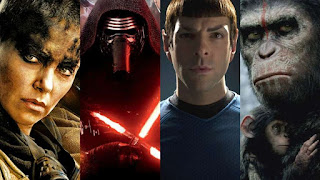
The 26 Best Sci-Fi Films of the Recent Decade

Sci- Fi   Films

It's a great time to be a science-fiction fan. Not only has special effects advanced to the point where robots and alien worlds have become life-like, but audiences seem to love the genre more than ever before. With
 raising the bar even further this year, here are the absolute best sci-fi films of the recent decade.

Social